
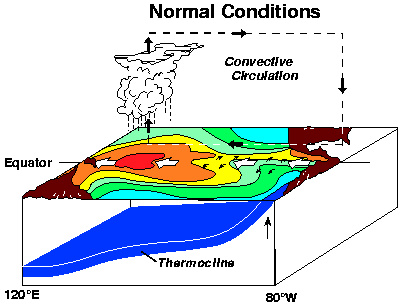
El Niño Southern Oscillation (ENSO) can be summarised as the interaction between the atmosphere and the ocean in the equatorial Pacific which effects global weather. Due to sedimental evidence it is known that El Niño and La Niña already occurred millions of years ago.
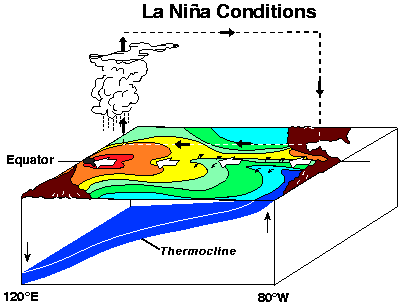
La Niña: La Niña is considered as the cold phase of ENSO. In the eastern tropical pacific, ocean temperatures appear to be lower than usual, caused by stronger easterly trade winds. Warm water is pushed to the western tropical pacific, therefore colder water rises in South and Central America. This circumstance has an impact on global weather. Australia, Indonesia and also the equatorial Pacific for example appear to be wetter than usual while South America faces droughts. Europe may face colder weather in the beginning of winter and a mild ending of winter. La Niña lasts for one to three years.
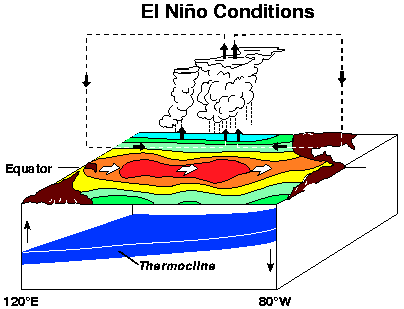
El Niño: In contrast to La Niña, El Niño is considered as the warm phase of ENSO. It occurs when trade winds weaken, air pressure falls, warm water flows back to the east of America and causes more rainfall and also floods because of intensified evaporation due to abnormal high temperatures in the eastern Pacific. El Niño can last up to one year. One issue of El Niño is the less nutritious warm water in the eastern Pacific which has negative effects on fisheries and primary productivity.
Simultaneously Australia faces droughts and sometimes bush fires.
Generally the prediction of such events is not reliable. But almost every El Niño is followed by a La Niña. Also there are debates wether climate change has an impact on both events.
For better understanding watch the Video from the National Ocean Service or read the article El Niño Southern Oscillation which is also available in other languages.
References
Brown, Jaci (2014): Explainer: El Niño and La Niña, The Conversation [online] Available from: https://theconversation.com/explainer-el-nino-and-la-nina-27719 [08 November 2023]
What is El Niño (n.d.) National Oceanic and Atmospheric Administration, United States Department of Commerce [online] Available from: https://www.pmel.noaa.gov/elnino/what-is-el-nino [08 November 2023]
What is La Niña? (n.d.) National Oceanic and Atmospheric Administration, United States Department of Commerce [online] Available from: https://www.pmel.noaa.gov/elnino/what-is-la-nina [08 November 2023]
El Niño Southern Oscillation (n.d.) Reef Resilience Network [online] Available from: https://reefresilience.org/stressors/climate-and-ocean-change/el-nino-southern-oscillation/ [08 November 2023]
 Earth‘s Legacy Blog
Leave a comment