
Originally and naturally the carbon cycle is a balanced system. Carbon-containing compounds in lithosphere, pedosphere, atmosphere, hydrosphere and biosphere are constantly moving. Carbon sources such as decomposition of organic substances, respiration, combustion of fossil fuels, volcano eruptions and also ruminant animals increase the amount of greenhouse gases (Co2, CH4). The opposite functioning carbon reducing sources (carbon sinks) for instance plants and trees, soil, the ocean and fossil fuels store carbon.
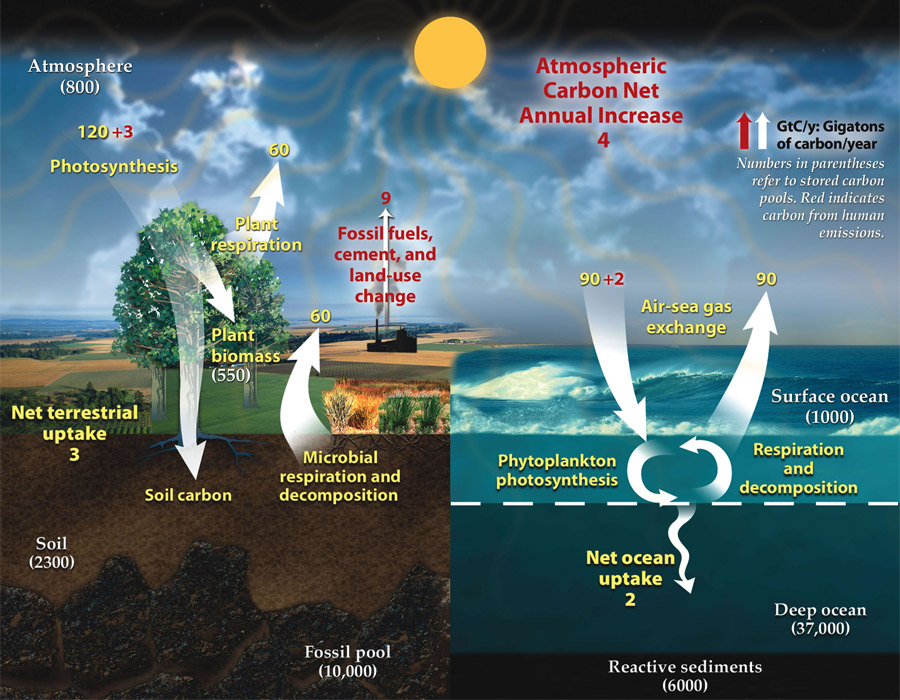
This graphic shows the carbon cycle. White Arrows show the direction the carbon circulates in between various spheres. The scale of it can be seen by looking at the amount of gigatons per year. Taking a closer look on the red numbers demonstrates the impact humanity has on the carbon cycle. Destroying carbon sinks enhances releasing of greenhouse gases which leads to increasing temperatures on earth. The balance of the carbon cycle is distracted by human actions. The earth on it’s own is a closed system which regulates itself. Therefore it is very likely that humans have a great impact on climate change.
It is humanities duty to rebalance the system by reducing carbon pollution and provide carbon sinks.
References
National Oceanic and Atmospheric Administration. (2023) What is the carbon cycle? [online] Available from: https://oceanservice.noaa.gov/facts/carbon-cycle.html [22 October 2023]
Center for Science Education, UCAR (n.d.), Carbon Cycle Diagram from the DOE with numbers [online] Available from: https://scied.ucar.edu/image/carbon-cycle-diagram-doe-numbers [19 October 2023]
 Earth‘s Legacy Blog
Leave a comment